The Pareto Principle: How to Get 80% of Your Results from 20% of Your Effort
80% of your results come from 20% of your effort. Here's where the Pareto principle comes from, three examples you'll recognize, and a simple method to find your own vital 20%.
What if I told you there is a way to achieve 80% of your work with only 20% of the effort? You might think this is too good to be true. Shortcuts don't exist, and only hard work brings results.
But we are not going to talk about shortcuts or "productivity hacks." We will not suggest delegating tasks to others, or using AI (even though we believe that using AI well can boost your productivity). This is about a much older idea: the Pareto principle, developed by the Italian economist Vilfredo Pareto in 1906, while he was teaching at the University of Lausanne.
What the Pareto principle actually says
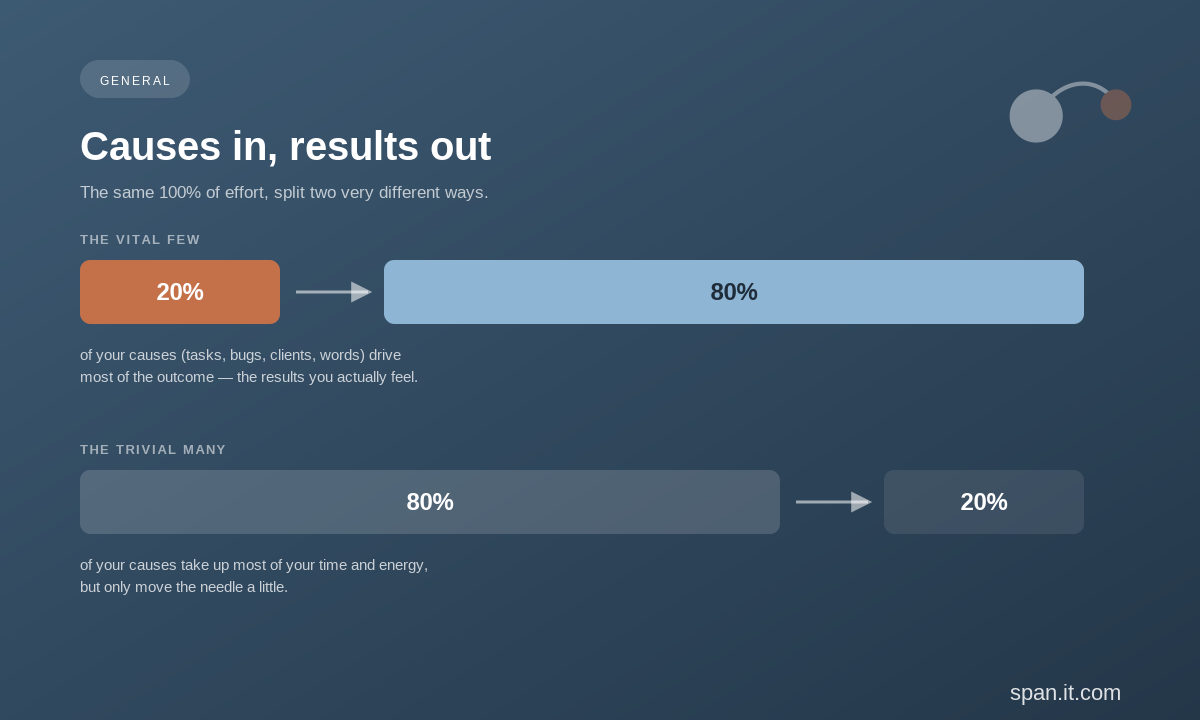
The principle says that for many outcomes, about 80% of the results come from 20% of the causes — the vital few. Pareto's own example: 20% of the population in Italy owned 80% of the land. Here are three examples we can find around us today:
- Software. Microsoft found that fixing the top 20% of the most reported bugs removed about 80% of the errors and crashes in a system.
- Taxes. In the USA, IRS data shows that the top 10% of earners pay about 70% of all income tax. The same pattern appears in many other countries.
- Language. A few hundred words cover most everyday English. So to speak English, you don't need the whole dictionary. You need a small set of words.
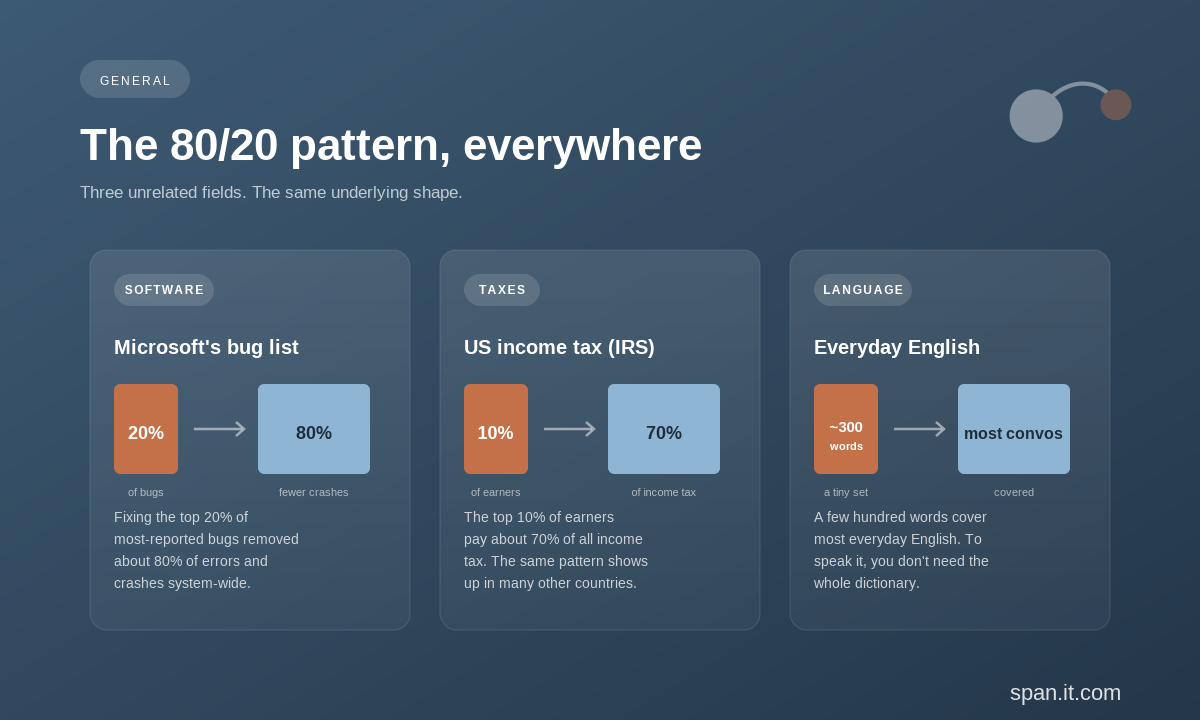
All these examples show that you can get most of the results you want by focusing on your few top priorities. This can change not only your work, but your personal life too, if you do it right.
The hard part: finding your 20%
But the most important question remains: how do you know which 20% deserves your time and attention? Here is the uncomfortable truth: most people cannot identify the 20% in advance. They discover it later, when the results don't come.
Here is how to do it, in four steps.

- List everything. Write down every task you have, without filtering.
- Score each task from 1 to 10, based on how much it moves you toward your actual goal. Be careful not to be biased by the tasks you enjoy — stay objective. You may find that the most important tasks are the least pleasant ones.
- Sort the list. Once the scoring is done, you have a backlog: your tasks ranked from most to least important.
- Start at the top. Whatever the highest-scoring task is, even if you don't like it, it deserves your attention first. Then the second, the third, and so on.
You will quickly see that after finishing the first quarter of your list, results come fast. You will also find that the remaining tasks often become irrelevant, or simply not worth your time. That is the magic of the 80/20 principle. (If part of your top 20% is getting your work seen at all, that's worth its own look — see how to digitize your freelance business for the same logic applied to visibility.)
Where the 80/20 rule doesn't apply
Keep in mind that this principle does not work everywhere. You cannot build 20% of a building — one floor out of five — and expect 80% of the result. Some outcomes need every part finished before any of it counts. But the Pareto principle applies to many situations we meet at work, and it is worth remembering every time you have to choose what to do first.
Frequently asked questions
What is the Pareto principle in simple terms?
The Pareto principle, also called the 80/20 rule, says that roughly 80% of outcomes come from about 20% of causes. In practice, a small number of your tasks or clients usually account for most of your results — the trick is identifying which ones.
Who created the 80/20 rule?
Italian economist Vilfredo Pareto first described the pattern in 1906, while teaching at the University of Lausanne, after observing that about 20% of the population in Italy owned about 80% of the land.
How do I find my own 20% that matters most?
List every task on your plate, score each one from 1 to 10 based on how much it actually moves you toward your goal (not how much you enjoy it), sort the list from highest to lowest score, and work down from the top.
Does the 80/20 rule always apply?
No. It works well for outcomes made of many small, separable contributions — like bugs, clients, or vocabulary. It breaks down for tasks that require every part to be finished before anything counts, like constructing a building.
Related
- How to Increase Your Profit
- How to Improve Your Operations
- Decision Fatigue: Why Small Decisions Drain Your Energy
- How Trust Is Built Online Between Strangers (And What Breaks It)
- Freelance Developer or Agency: What the Extra Money Actually Buys
Explore SPAN
- The tools to run your work. The network to grow it.
- Find Freelancers in Lebanon
- Services Near You in Lebanon
- Guides for Running a Business in Lebanon
- SPAN for Your Business
- The SPAN Blog
- About SPAN
- Contact & Support
- Privacy Policy — SPAN
- Terms of Use & Community Guidelines — SPAN
- Calendar
- Search & Discover Professionals
- Messages
- Home Feed
- Profile & Portfolio
- Booking
- Finances
- Clients in SPAN