How Trust Is Built Online Between Strangers (And What Breaks It)
You've never met them. But you're about to hire them. Here's how online trust actually works — and what makes it collapse before it even starts.
You've never met them. But you're about to hire them.
That's the reality of finding someone online. No referral from a friend, no handshake, no gut feeling from a face-to-face conversation. Just a profile, a few photos, and a name you've never heard before.
So how do people decide to trust a stranger on the internet? And more importantly — what makes that trust collapse before it even starts?
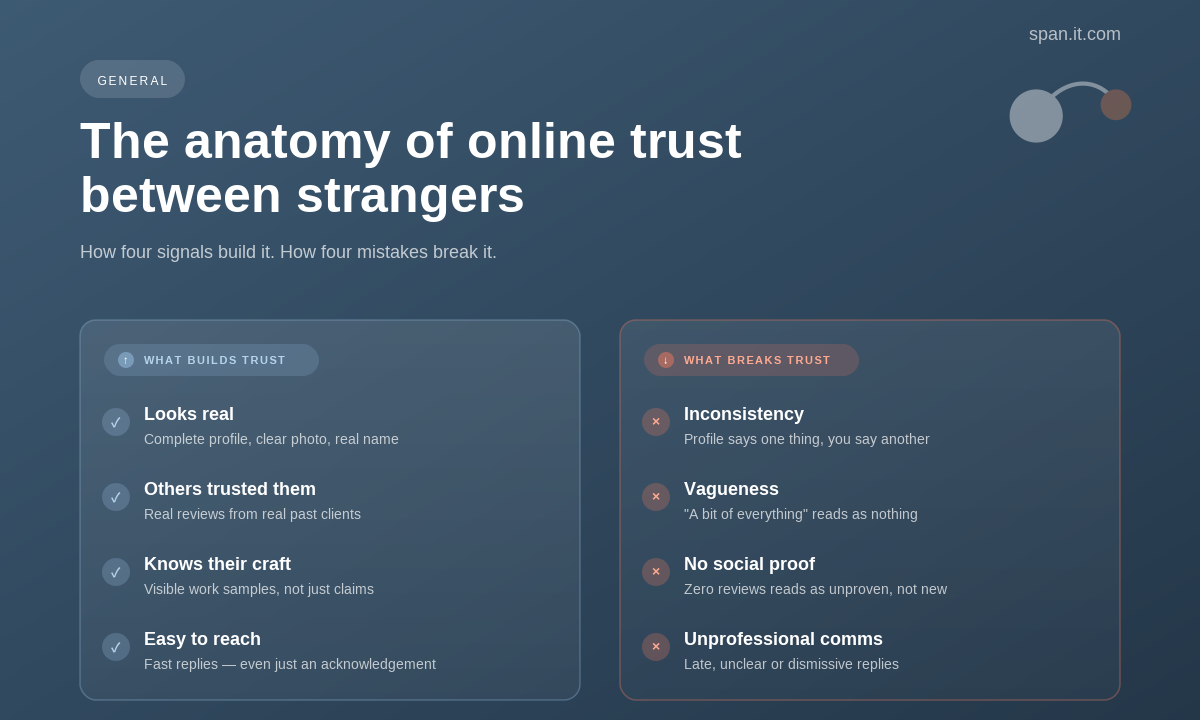
Trust isn't built in one moment. It's accumulated in layers.
When someone lands on a freelancer's profile for the first time, they're not making one decision. They're running a series of quick, mostly unconscious checks.
Does this person look real? A complete profile with a clear photo, a real name, and consistent information signals that someone exists — and that they're not hiding. Incomplete profiles fail this check instantly.
Have other people trusted them before? Reviews are the closest thing to word of mouth on the internet. A profile with five genuine reviews from real clients carries more weight than a perfect bio with zero feedback. Past trust is proof of future reliability.
Do they know what they're talking about? Showing your work — photos, past projects, descriptions of what you do — tells the person on the other side that you've done this before. Confidence comes from evidence, not claims.
Can I reach them easily? Responsiveness signals respect. A freelancer who replies quickly, even just to acknowledge a message, communicates that they take their work seriously. Silence, even for a few hours, introduces doubt.
What breaks trust — fast.
Trust takes time to build and seconds to lose. Here's what kills it immediately:
- Inconsistency. A profile that says one thing and a conversation that says another. If your rates, availability, or services don't match what you've listed, people leave.
- Vagueness. "I do a bit of everything" is not a positioning. It's a red flag. People want to hire someone who knows exactly what they do.
- No social proof. Zero reviews on a profile doesn't mean you're new. To a stranger, it means you're unproven. The first few reviews you collect are the most important ones of your career.
- Unprofessional communication. Late replies, unclear answers, or a tone that feels dismissive. The way you communicate before the job starts tells the client everything about how you'll communicate during it.
The bottom line.
Online trust is not magic. It's a system — and once you understand how it works, you can build it deliberately.
A complete profile. Real reviews. Work that speaks for itself. Responses that come quickly. These are not small details. They are the entire foundation of your reputation online.
At SPAN, we built the platform around exactly this. Because when trust is in place, everything else follows.
Related
- Find a Freelancer in Lebanon
- Profile & Portfolio
- Decision Fatigue: Why Small Decisions Drain Your Energy
- The Pareto Principle: How to Get 80% of Your Results from 20% of Your Effort
- Freelance Developer or Agency: What the Extra Money Actually Buys
Explore SPAN
- The tools to run your work. The network to grow it.
- Find Freelancers in Lebanon
- Services Near You in Lebanon
- Guides for Running a Business in Lebanon
- SPAN for Your Business
- The SPAN Blog
- About SPAN
- Contact & Support
- Privacy Policy — SPAN
- Terms of Use & Community Guidelines — SPAN
- Calendar
- Search & Discover Professionals
- Messages
- Home Feed
- Profile & Portfolio
- Booking
- Finances
- Clients in SPAN