Why Hiring Through WhatsApp Groups Is Costing You More Than You Think
Word-of-mouth hiring feels efficient. But it filters by who's available, not who's best. Here's the real cost of informal hiring — and what a better process looks like.
You need someone. You post in a group, ask a contact, or text a friend who "knows people." Three names land in your inbox by evening. It feels efficient. It feels safe.
It often isn't either.
The Problem With "Warm" Recommendations
Word-of-mouth has a filter built into it. That filter isn't skill. It isn't fit. It's proximity.
The person who gets recommended is the one your contact happens to remember, happened to work with recently, or happened to be available. Their work might be great. But the recommendation tells you almost nothing about whether they're right for your project, your timeline, or your standards.
The person vouching for them probably isn't a designer evaluating design work, or a developer evaluating code quality. They're a person who had a fine experience and wants to be helpful. That's genuinely kind. It's just not the same as a qualified signal.
You're Absorbing Risk You Can't See
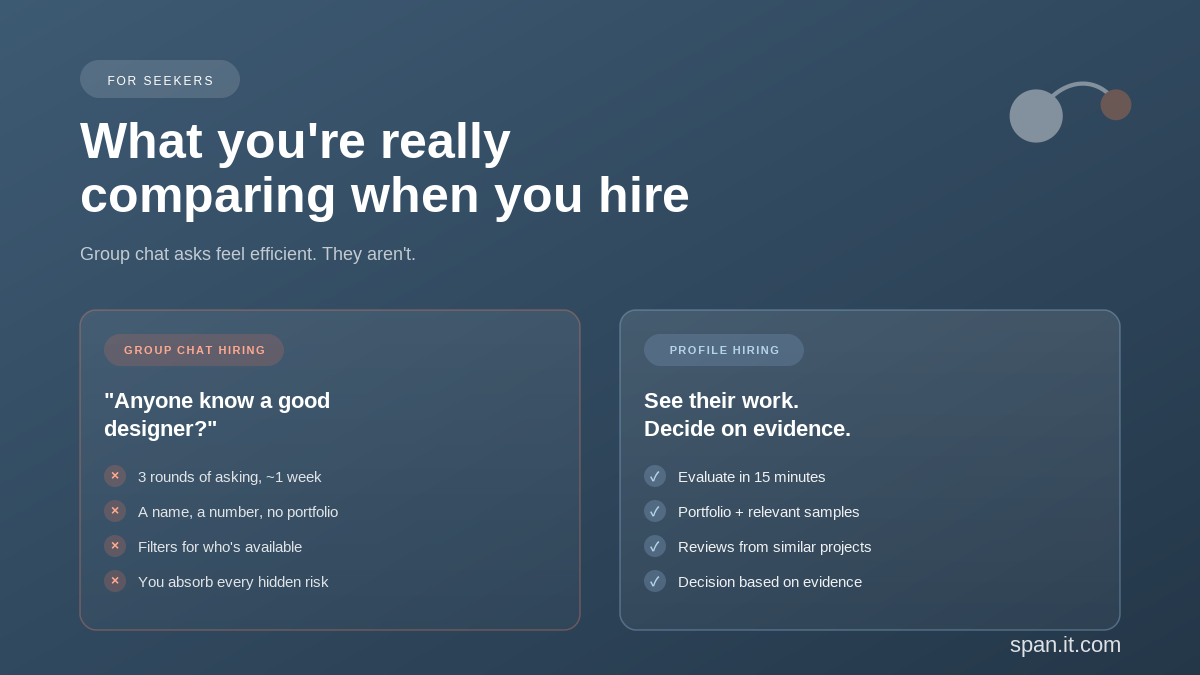
When you hire through a group chat, you typically get a name and a number. Maybe a vague description. "She does social media stuff." "He built my cousin's website."
No portfolio. No examples of relevant work. No reviews from people with similar projects. No sense of how they handle revisions, missed deadlines, or scope creep.
So you get on a call. They seem nice. You move forward on instinct.
That instinct might be right. But when it's wrong, you absorb the full cost: the wasted brief, the back-and-forth, the delay, sometimes the whole budget. And then you're back in the group chat, asking again.
The "Three Rounds of Asking" Tax
Informal hiring isn't just risky. It's slow in ways that don't feel slow until you add them up.
Round one: you ask, you wait, you get names.
Round two: someone doesn't reply, someone else isn't available, you ask again.
Round three: you settle for whoever responded.
That process can take a week. And at the end of it, you still haven't seen a single piece of their actual work.
Compare that to reviewing a structured profile with a real portfolio, past client reviews, and a clear description of what they do and how they work. You can evaluate that in fifteen minutes. You can make a genuinely informed decision instead of an optimistic one.
Availability Is Not a Qualification
This is the quiet trap of informal hiring. The person who gets the job is often the one who was easiest to reach, not the one best suited for the work.
That's not a flaw in the people being recommended. It's a flaw in the method. A system that selects for social proximity and responsiveness will consistently underperform a system that selects for demonstrated skill and relevant experience.
You're not being careless when you hire this way. You're using the tools you have. But it's worth naming what those tools actually optimize for, because it isn't quality.
What a Better Process Actually Looks Like
Finding a reliable freelancer doesn't require a long procurement process or a formal RFP. It requires a few things informal hiring almost never gives you:
- Work samples you can actually evaluate
- Reviews from people who hired them for similar work
- A clear sense of how they communicate and what working with them looks like
When those things are visible upfront, the decision gets faster, not slower. You're not chasing references or hoping for the best. You're choosing based on evidence.
That shift, from vibes to verified signals, is what turns hiring from a gamble into a process you can trust.
This is what SPAN is built around: giving seekers real information about the people they're considering, and giving freelancers a place to show their actual work. Visit span.it.com.
The right person for your project exists. The goal is to find them on purpose.
Related
- Home Services in Lebanon
- Find a Handyman in Lebanon
- Freelance Developer or Agency: What the Extra Money Actually Buys
- Graphic Designer or Brand Studio: Are You Buying a Logo or a System?
- $200 a Month for Social Media — But Is the Ad Spend Inside That Number?
Explore SPAN
- The tools to run your work. The network to grow it.
- Find Freelancers in Lebanon
- Services Near You in Lebanon
- Guides for Running a Business in Lebanon
- SPAN for Your Business
- The SPAN Blog
- About SPAN
- Contact & Support
- Privacy Policy — SPAN
- Terms of Use & Community Guidelines — SPAN
- Calendar
- Search & Discover Professionals
- Messages
- Home Feed
- Profile & Portfolio
- Booking
- Finances
- Clients in SPAN