What to Do When a Client Ghosts You
You sent the proposal. Or delivered the work. And then — nothing. Here's how to handle being ghosted without losing your professionalism or your time.
You sent the proposal. Or delivered the work. Or followed up once. And then — nothing.
Being ghosted by a client is one of the most frustrating experiences in freelance work. Not because it's rare — it happens to everyone — but because the silence leaves you in limbo. Do you follow up? Do you move on? Did you do something wrong?
Here's how to handle it — without losing your professionalism or your time.
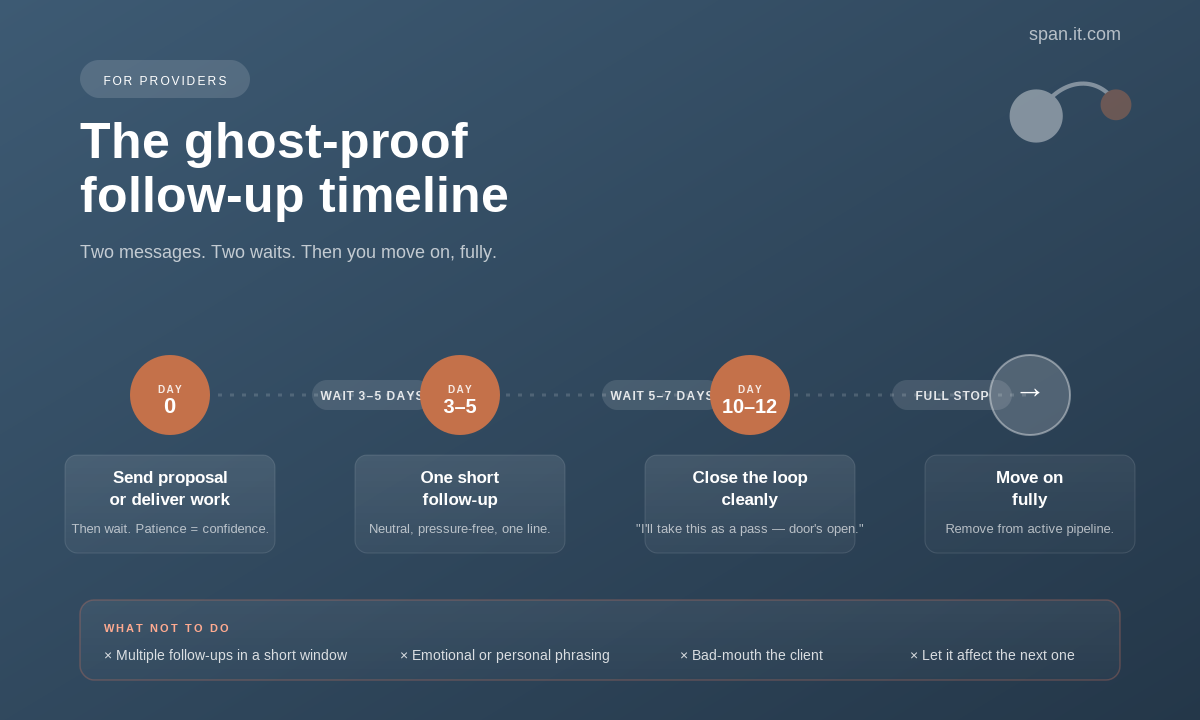
First: understand why it happens.
Clients ghost for many reasons, and most of them have nothing to do with you.
- They got busy and your message dropped down the list
- They're comparing multiple freelancers and haven't decided yet
- The project was paused or cancelled internally
- They felt awkward saying no and chose silence instead
Ghosting is almost never personal. Treating it as such is the first mistake.
The right response — step by step.
Step 1: Wait before you follow up. After a proposal or delivery, give the client 3–5 business days before sending anything. Following up the next day signals anxiety. Patience signals confidence.
Step 2: Send one follow-up. One. Keep it short, neutral, and pressure-free. Something like:
> "Just checking in on [the proposal / the work I delivered]. Happy to answer any questions if you have them."
No guilt. No urgency. No "just wanted to make sure you received this" — they received it. One clean follow-up is professional. Two starts to feel like pressure.
Step 3: If there's still no response — close the loop. After another 5–7 days of silence, send a final message. Not to chase, but to give yourself closure and leave the door open:
> "I'll take this as a pass for now — no problem at all. If anything changes or a new project comes up, I'm here."
This is the most underused move in freelancing. It's confident, it's clean, and it occasionally brings people back who weren't ready before.
Step 4: Move on — fully. Don't hold mental space for a client who hasn't responded. Remove them from your active pipeline. If they come back, great. If not, you've lost nothing by letting go.
What not to do.
- Don't send multiple follow-ups in a short window
- Don't make it emotional or personal in your message
- Don't bad-mouth the client — the freelance world is smaller than you think
- Don't let one ghost affect how you show up for the next client
The bottom line.
Ghosting is a normal part of freelance work. The way you handle it — calmly, professionally, without chasing — says more about you than any proposal ever could.
The clients worth working with will respond. The ones who don't weren't the right fit anyway.
Protect your time. Protect your energy. And keep moving.
Related
- How to Keep Clients Coming Back
- Messages
- How SPAN Ranks Search Results
- What Is Freelancing? A Simple Guide for Anyone Starting Out
- How to Digitize Your Freelance Business (and Why It Pays Twice)
Explore SPAN
- The tools to run your work. The network to grow it.
- Find Freelancers in Lebanon
- Services Near You in Lebanon
- Guides for Running a Business in Lebanon
- SPAN for Your Business
- The SPAN Blog
- About SPAN
- Contact & Support
- Privacy Policy — SPAN
- Terms of Use & Community Guidelines — SPAN
- Calendar
- Search & Discover Professionals
- Messages
- Home Feed
- Profile & Portfolio
- Booking
- Finances
- Clients in SPAN