How to Vet a Freelancer Before You Hire Them
Finding a freelancer is easy. Finding the right one takes five minutes more. Here's a simple framework to vet a freelancer properly — before you say yes.
Finding a freelancer is easy. Finding the right one takes five minutes more.
There are more skilled freelancers available today than at any point in history. The challenge isn't availability — it's knowing who to trust before you commit your time, your money, and your project to someone you've never worked with.
Here's a simple framework to vet a freelancer properly — before you say yes.
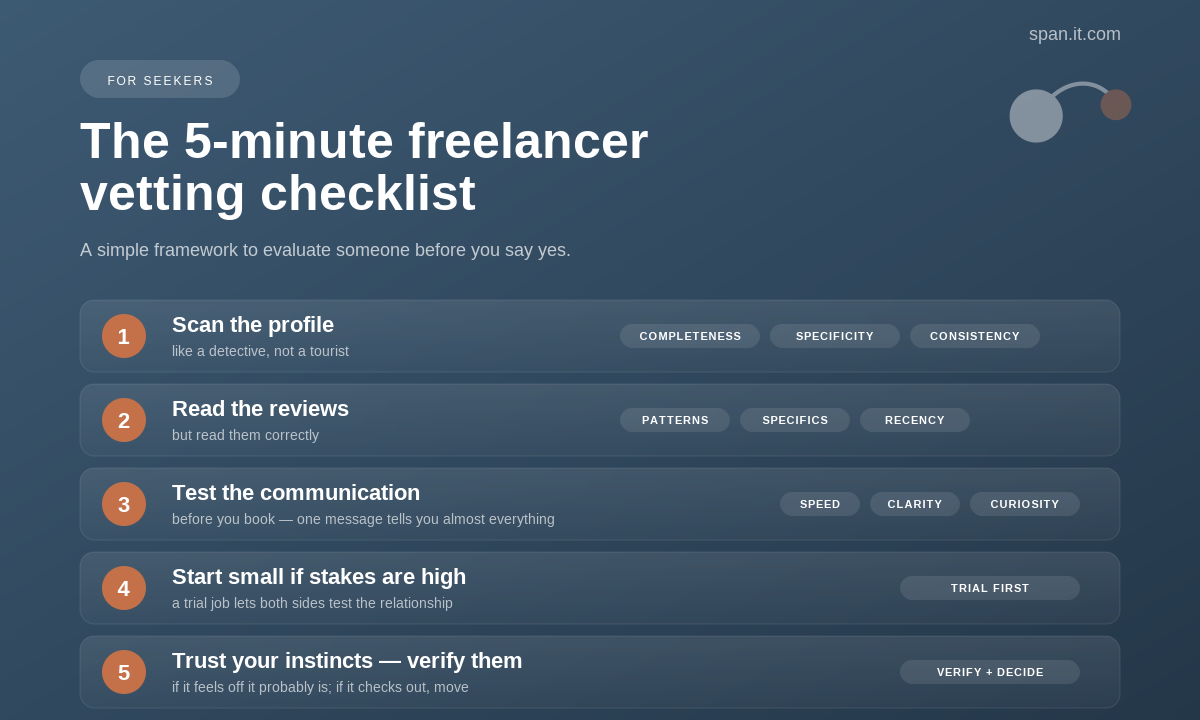
1. Look at the profile like a detective, not a tourist.
Most people browse a freelancer's profile passively. They look at the photo, skim the bio, and move on. Instead, look for signals.
Completeness: A fully filled profile — photo, description, services, past work — signals professionalism. Someone who hasn't invested five minutes in their own profile is unlikely to invest fully in yours.
Specificity: The best freelancers are clear about what they do and who they do it for. Vague generalists are a risk. Specific professionals are a signal.
Consistency: Does the bio match the portfolio? Does the experience match the rates? Inconsistency is a flag worth noting.
2. Read the reviews — but read them correctly.
Reviews are your most valuable signal, but only if you read them well.
- Look for patterns, not outliers. One bad review among fifteen good ones tells a different story than three bad reviews among five.
- Look for specifics. A review that says "great work, highly recommend" tells you little. A review that says "delivered on time, communicated clearly, handled revisions without issue" tells you everything.
- Look at recency. A freelancer with strong reviews from two years ago but nothing recent may have changed — in availability, quality, or commitment.
3. Test the communication before the job starts.
Send a message before you book. Ask a simple question about your project. You're not testing their answer — you're testing three things:
- How quickly they respond
- How clearly they communicate
- Whether they ask good questions back
A freelancer who responds promptly, writes clearly, and asks relevant questions about your needs is already showing you how they'll behave on the job. That's the clearest signal you'll get before hiring.
4. Start small if the stakes are high.
If the project is large or the budget is significant, don't start with the full scope. Offer a smaller first task — a trial job that lets both sides test the relationship before fully committing.
This is not an insult to the freelancer. It's good practice. The best freelancers will understand and respect it.
5. Trust your instincts — but verify them.
If something feels off, it probably is. But also: if everything checks out and you still feel uncertain, that's usually nerves, not intuition. Do the checklist. If it passes, move forward.
The bottom line.
Hiring a freelancer well is a skill. The good news is it's a simple one — and it gets faster every time you do it.
Profile. Reviews. Communication. Start small. That's the entire framework.
At SPAN, every profile is built to give you exactly this information — so you can make the right call, fast.
Related
- Find a Freelancer in Lebanon
- Hire a Virtual Assistant in Lebanon
- Freelance Developer or Agency: What the Extra Money Actually Buys
- Graphic Designer or Brand Studio: Are You Buying a Logo or a System?
- $200 a Month for Social Media — But Is the Ad Spend Inside That Number?
Explore SPAN
- The tools to run your work. The network to grow it.
- Find Freelancers in Lebanon
- Services Near You in Lebanon
- Guides for Running a Business in Lebanon
- SPAN for Your Business
- The SPAN Blog
- About SPAN
- Contact & Support
- Privacy Policy — SPAN
- Terms of Use & Community Guidelines — SPAN
- Calendar
- Search & Discover Professionals
- Messages
- Home Feed
- Profile & Portfolio
- Booking
- Finances
- Clients in SPAN