How to Get Clients as a Freelancer: Inbound vs Outbound
Most freelancers run only one loop, inbound or outbound. The ones who grow steadily run both, in the right mix for their stage. Here is the playbook.
Most freelancers run only one loop. Either they wait for clients to find them, or they spend their days chasing. Both work. Both fail when run alone.
Getting clients is not one job. It is two. Inbound is the work of being found. Outbound is the work of finding. The freelancers who grow steadily run both, in the right mix for where they are.
Inbound: clients come to you
Inbound is everything you build once that keeps working while you sleep. A profile someone discovers. A portfolio someone shares. A post that gets seen. A referral from a happy client.
The tools that matter:
- A profile that ranks. Your name, your skill, your location, your work. The more complete and specific, the more searchable you are. Generic profiles get skipped.
- Portfolio of real work. Photos, before-and-afters, case notes. Three strong pieces beat thirty weak ones.
- Content cadence. Post your work as you do it. One post a week is enough if it shows the craft. Consistency wins over volume.
- Reviews and referrals. Ask every happy client for one. A short text is fine. Five reviews change how strangers see you.
- A single home base. One page that holds all of it. SPAN gives you that home base, with profile, calendar, and booking in one place, so every link you send out leads back to one source of truth.
Inbound is slow at first and compounds later. You will not see the curve for the first month. You will rely on it by month six.
Outbound: you go to clients
Outbound is direct effort. You reach a specific person with a specific message. Faster than inbound. More work per lead. Lower conversion, but immediate.
The tools that matter:
- Targeted DMs. Pick ten people who match your ideal client. Send a short, personal message. Not a pitch. A question or an offer of help.
- Local networking. Coworking spaces, trade groups, neighborhood businesses. Show up, say what you do in one sentence, leave a way to contact you.
- Partnerships. Find a freelancer in a connected craft. A photographer pairs with a stylist. A plumber pairs with an electrician. Send each other work.
- Cold outreach with proof. When you reach out, lead with a piece of work that fits the person you are messaging. Generic copy gets ignored. Tailored proof gets replies.
Outbound is fast but draining. You stop, the work stops.
The mix changes with your stage
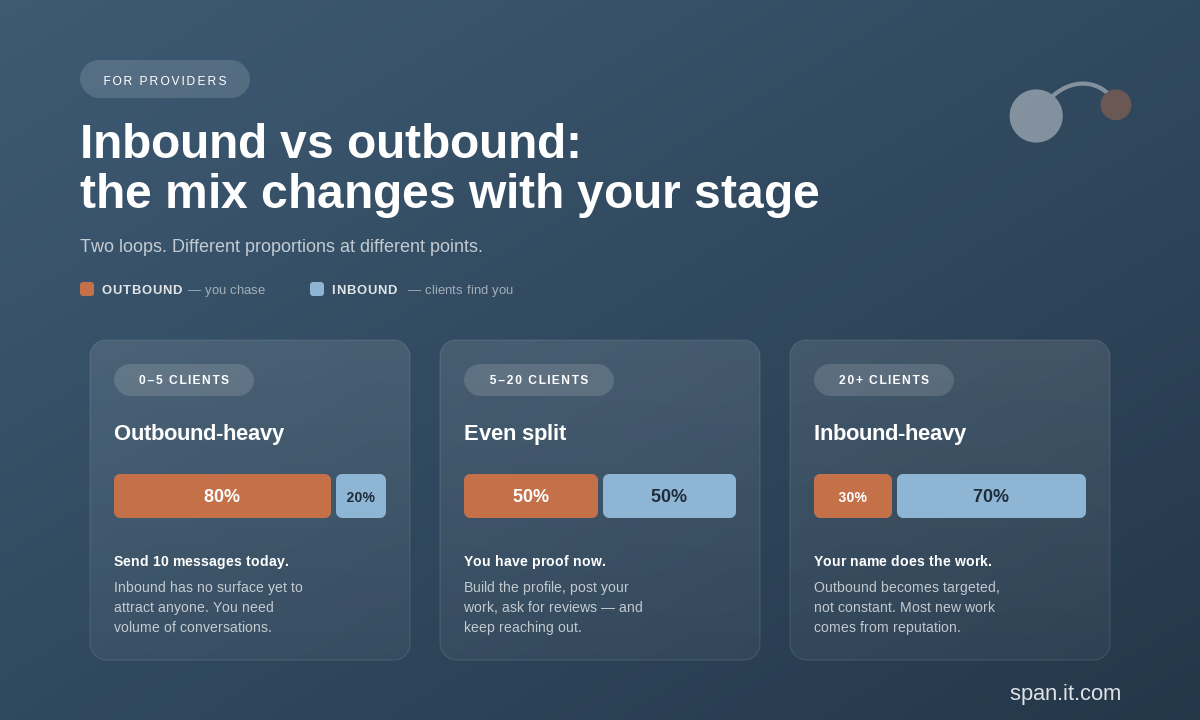
- 0 to 5 clients. Outbound-heavy. You need volume of conversations. Inbound has no surface yet to attract anyone. Spend 80% of your time reaching out.
- 5 to 20 clients. Even split. You have proof now. Build your profile, post your work, ask for reviews. Keep outbound running for new categories or higher-value clients.
- 20+ clients. Inbound-heavy. Your name starts doing the work. Outbound becomes targeted, not constant. Most new work comes from reputation and referrals.
The mistake is staying in outbound mode forever. The other mistake is jumping to inbound too early, before you have anything to be found for.
One next step
Pick the loop you are weaker on. If you have a steady inbound pipeline but no time to chase, you do not need a new tool, you need to send three messages today. If you are exhausted from chasing, stop for one afternoon and build the profile that does the chasing for you.
Both loops, in the right order. That is how you build a name that brings the work to you.
Related
- How to Find Clients in Lebanon
- How to Find Clients in Jounieh
- How SPAN Ranks Search Results
- What Is Freelancing? A Simple Guide for Anyone Starting Out
- How to Digitize Your Freelance Business (and Why It Pays Twice)
Explore SPAN
- The tools to run your work. The network to grow it.
- Find Freelancers in Lebanon
- Services Near You in Lebanon
- Guides for Running a Business in Lebanon
- SPAN for Your Business
- The SPAN Blog
- About SPAN
- Contact & Support
- Privacy Policy — SPAN
- Terms of Use & Community Guidelines — SPAN
- Calendar
- Search & Discover Professionals
- Messages
- Home Feed
- Profile & Portfolio
- Booking
- Finances
- Clients in SPAN