How to Ask for a Review Without Feeling Awkward
The job is done. The client is happy. And you say nothing. Here's how to ask for a review the right way — without it feeling like a request for a compliment.
The job is done. The client is happy. And you say nothing.
Most freelancers deliver great work and then disappear. They don't ask for a review because it feels uncomfortable — like asking for a compliment. So they move on, and the client moves on, and the work is never documented.
This is one of the most common and most costly mistakes a freelancer can make.
Why reviews matter more than you think.
A satisfied client who doesn't leave a review is invisible to everyone else. They know you're good. You know you're good. But the next person who finds your profile has no way of knowing that.
Reviews are not vanity metrics. They are the primary way trust transfers from one stranger to another online. Every review you collect is a silent referral — working for you around the clock, long after the job is finished.
The freelancers who grow fastest are rarely the most talented. They're the ones who are best at capturing proof of their talent.
Why asking feels awkward — and why that's normal.
Asking for a review can feel like asking someone to do you a favour. And in a way, it is. But here's the reframe: your client is happy. They already think highly of you. All you're doing is giving them a simple way to say so.
The awkwardness comes from timing and phrasing. Get those right, and it stops feeling like a request and starts feeling like a natural close to a good job.
How to ask — the right way.
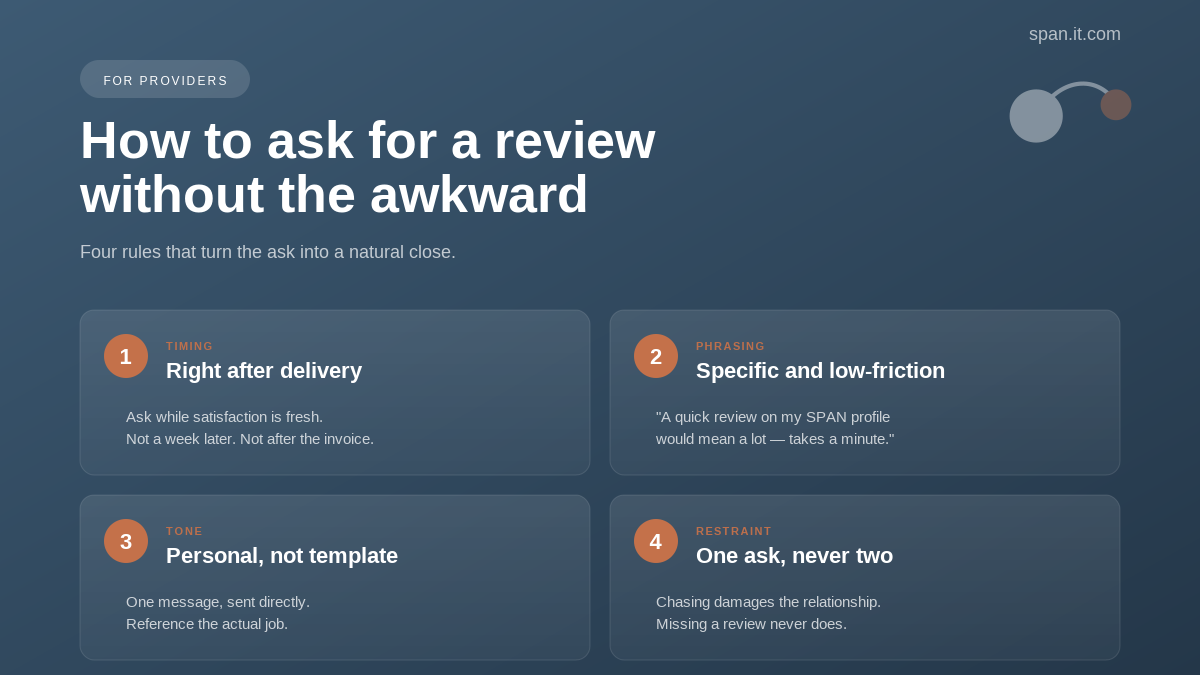
- Ask at the right moment. The best time to ask for a review is immediately after delivery — when the client has just seen the result and their satisfaction is at its peak. Don't wait a week. Don't wait until the invoice is paid. Ask while the feeling is fresh.
- Make it specific and easy. Don't say "feel free to leave a review if you have time." Say: "If you're happy with the work, a quick review on my SPAN profile would mean a lot — it only takes a minute." Specific. Low friction. Gives them a clear action.
- Keep it personal, not transactional. One message, sent directly. Not a copy-paste template they can feel from a mile away. Reference the job you did together. Make it feel like a conversation, not a process.
- Never ask twice. If they don't respond, let it go. Chasing a review damages the relationship more than missing it. One ask, delivered well, is enough.
A simple message that works.
> "Really glad you're happy with [the work]. If you'd like to leave a quick review on my SPAN profile, I'd really appreciate it — it helps a lot. Either way, great working with you."
Short. Human. No pressure. That's all it takes.
The bottom line.
Asking for a review is not self-promotion. It's documentation. It's how you turn one happy client into proof that the next client can trust you.
The best time to start was your last job. The second best time is your next one.
Related
- How to Keep Clients Coming Back
- Profile & Portfolio
- How SPAN Ranks Search Results
- What Is Freelancing? A Simple Guide for Anyone Starting Out
- How to Digitize Your Freelance Business (and Why It Pays Twice)
Explore SPAN
- The tools to run your work. The network to grow it.
- Find Freelancers in Lebanon
- Services Near You in Lebanon
- Guides for Running a Business in Lebanon
- SPAN for Your Business
- The SPAN Blog
- About SPAN
- Contact & Support
- Privacy Policy — SPAN
- Terms of Use & Community Guidelines — SPAN
- Calendar
- Search & Discover Professionals
- Messages
- Home Feed
- Profile & Portfolio
- Booking
- Finances
- Clients in SPAN