How to Approach Clients as a Freelancer
Outbound selling for freelancers, a step-by-step system to find the right clients, write messages that get replies, and turn cold contacts into booked work.
Most freelancers wait for work to find them. They post, they hope, and they ride the highs and lows that come with it. Outbound selling flips that. You reach out first, on purpose, to the people you want to work with.
Done well, it gives you a steady stream of clients instead of feast and famine. Done badly, it wastes your time and damages your name. The difference is not luck. It is a system anyone can run, even if you have never sold anything in your life.
Here is that system, step by step.
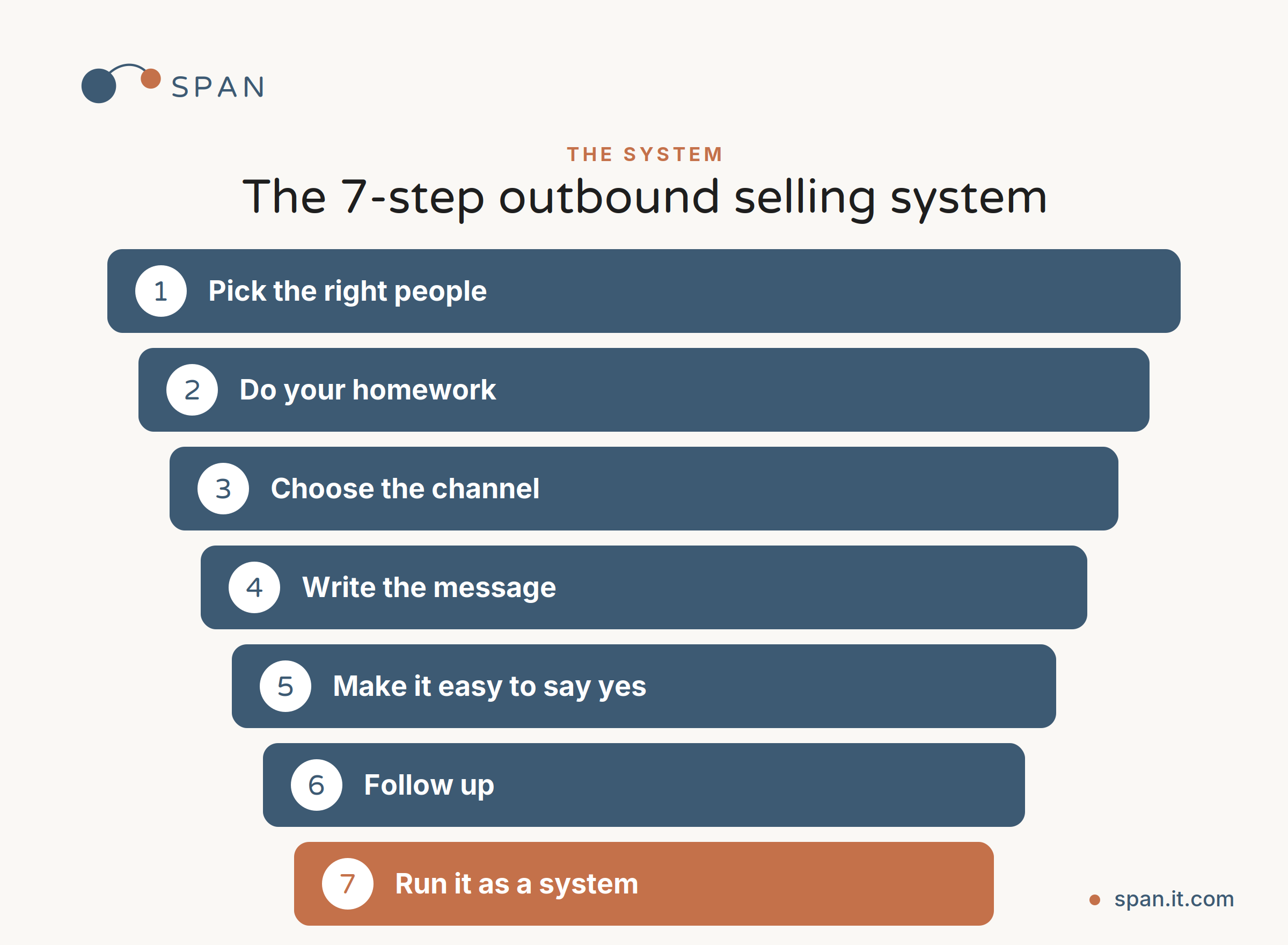
The short version
- Pick a clear group of people to approach, not everyone.
- Research each one before you message them.
- Reach them where they already are.
- Send a short message about their problem, not your resume.
- Make it easy to see your work and book you.
- Follow up. Most replies come on the second or third try.
- Track it and do it consistently.
What is outbound selling for a freelancer?
Inbound is when clients come to you. Outbound is when you go to them first. You send the message, you make the call, you start the conversation.
Both matter, but outbound gives you something inbound cannot: control. You do not have to wait. You decide who you want to work with and you go talk to them. It also works faster, because you are reaching people who would never have found you on their own.
Step 1: Pick the right people to approach
The biggest mistake is trying to reach everyone. A message built for everyone speaks to no one.
Instead, get specific. Ask yourself three questions:
- What kind of work do I most want more of?
- Who needs that work and can pay for it?
- Where are those people, and what do they have in common?
A photographer might target new restaurants that need menu and interior shots. A bookkeeper might target small shops that just registered. The tighter your group, the easier every step after this becomes.
Step 2: Do your homework before you reach out
This is the step that separates a reply from the spam folder. Before you write anything, spend two minutes learning about the person or business. Look at their website, their recent posts, their reviews.
You are looking for one real detail you can mention. A new branch they opened. A service they just launched. A gap you noticed. That single specific line proves you are talking to them, not blasting the same note to a hundred people. People want to feel understood, not sold to.
Step 3: Choose the right channel
Reach people where they already are, not where it is easiest for you.
- Direct message works well for visual work and younger businesses that live on social media.
- Email works for established businesses and anything that needs a clear written proposal.
- In person still works, especially for local businesses. Walking in and introducing yourself is rare enough now that it stands out.
- Referrals are the strongest of all. A warm introduction from a happy client comes with trust already built in. Always ask satisfied clients if they know someone else who could use your help.
Step 4: Write a message that gets a reply
Picture someone walking up to you and immediately listing their achievements and why you should hire them. You would tune out. That is what a self-focused pitch feels like.
A good outreach message does the opposite. Keep it short. Lead with their situation. Make one clear, easy ask. Here are three you can adapt.
Cold email
Subject: Quick idea for [business name]
Hi [name],
I came across [specific detail, e.g. your new location on the main road] and noticed [the small gap or opportunity]. I help [type of business] with [what you do], and I think there is a quick win here.
Would you be open to a short call this week? Either way, here is some of my recent work: [link].
Thanks, [Your name]
Social DM
Hi [name], really liked [specific post or project]. I do [what you do] for [type of client] and had one idea that could help with [their goal]. Want me to send it over?
Referral ask
Hi [name], glad you were happy with [the work you did]. I am taking on a couple of new clients this month. Do you know anyone who might need [what you do]? A quick intro would mean a lot.
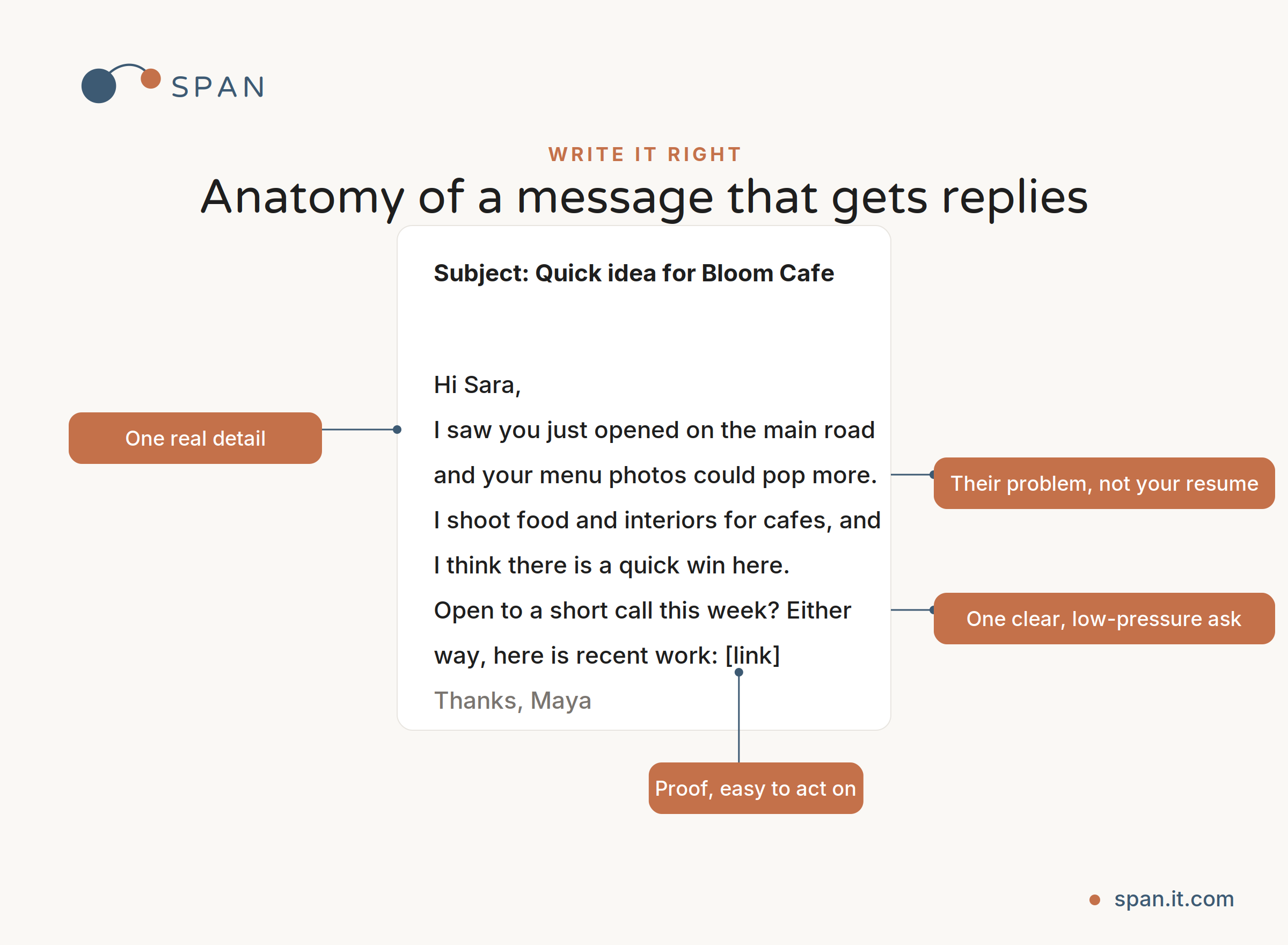
Notice the pattern: about them, short, one ask, no pressure.
Step 5: Make it easy to say yes
You can write the perfect message and still lose the client at the last step, because saying yes was too much work.
Two things remove that friction. First, proof: a clean profile or portfolio that shows real work and real reviews, so they trust you in seconds. Second, a simple way to book: one link where they can see what you do and pick a time, without a dozen back-and-forth messages. This is exactly what a free SPAN profile and booking link are built to give every freelancer, so an interested client can go from curious to booked in a tap.
Step 6: Follow up, because this is where the work is
Most freelancers send one message, hear nothing, and quit. But the reply usually comes on the second or third touch, not the first. People are busy and your note slips down their inbox.
Wait about a week, then send a short, polite follow up. Restate your idea in one line and remind them you are still happy to help. Two or three follow ups is normal and professional. It is not annoying, it is how business gets done.
Step 7: Turn it into a system
One burst of outreach gives you one burst of work. A system gives you a steady pipeline.
Keep a simple list of who you contacted, when, and what they said. A free spreadsheet is enough. Set a small, repeatable goal, like five new messages a day. Consistency beats intensity every time.
And remember outreach is a numbers game. Most people will not reply, and that is fine. Every no gets you closer to a yes. Do not take silence personally. Keep refining your message and keep going.
Common mistakes to avoid
- Sending the same generic message to everyone.
- Talking about yourself instead of their problem.
- Giving up after one try.
- Making your work hard to find or yourself hard to book.
- Chasing clients you do not actually want to work with.
Start this week
You do not need a big audience or years of experience to land clients through outreach. You need a clear target, a little homework, a short honest message, and the patience to follow up.
Pick ten people this week. Research them. Send ten real messages. Track what happens. That is outbound selling, and it is how you build a name that brings work to you over time.
Related
- How to Find Clients in Beirut
- Messages
- How SPAN Ranks Search Results
- What Is Freelancing? A Simple Guide for Anyone Starting Out
- How to Digitize Your Freelance Business (and Why It Pays Twice)
Explore SPAN
- The tools to run your work. The network to grow it.
- Find Freelancers in Lebanon
- Services Near You in Lebanon
- Guides for Running a Business in Lebanon
- SPAN for Your Business
- The SPAN Blog
- About SPAN
- Contact & Support
- Privacy Policy — SPAN
- Terms of Use & Community Guidelines — SPAN
- Calendar
- Search & Discover Professionals
- Messages
- Home Feed
- Profile & Portfolio
- Booking
- Finances
- Clients in SPAN