The 5 Biggest Pain Points Freelancers Face
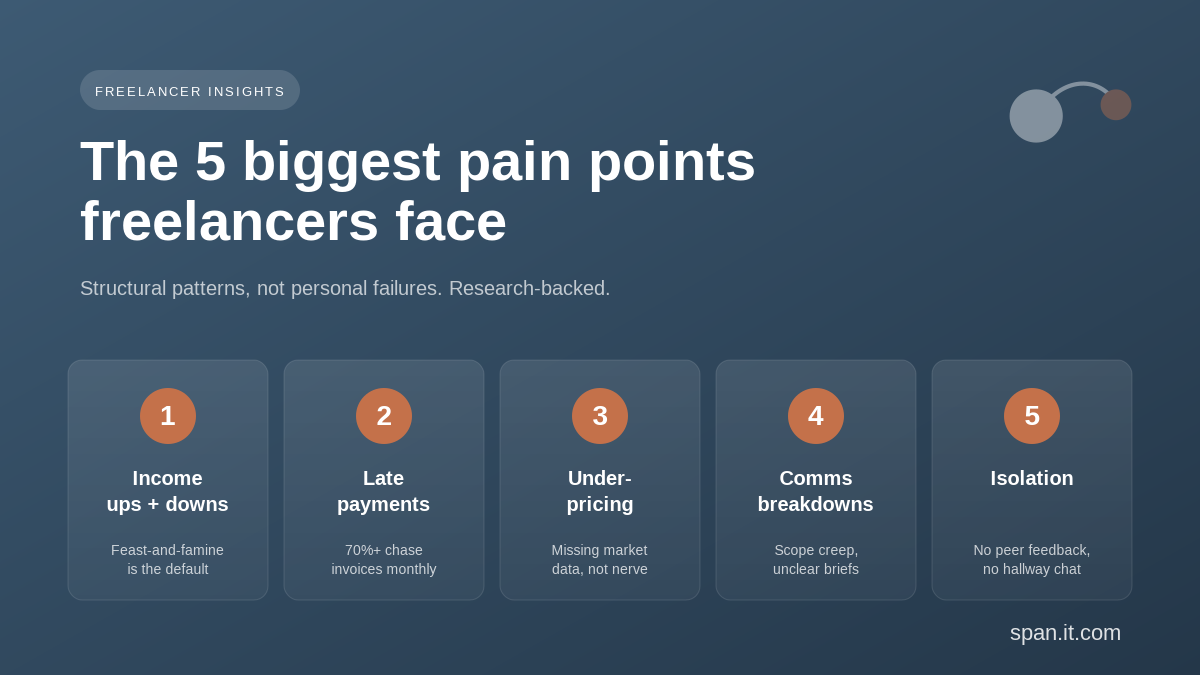
Most freelancers assume their struggles are personal failures. They're not. They're structural patterns, and the research says so. Here's what to do about each.
Most freelancers assume their struggles are personal failures. They're not. They're structural patterns, and the research says so.
The 2023 Freelance Forward report published by Upwork surveyed over 6,000 independent workers across industries and experience levels. The findings aren't surprising if you've lived them. But naming the patterns precisely changes how you respond to them. A personal flaw needs fixing. A structural problem needs a system.
Here's what the research surfaced, and what you can actually do about each one.
Income Unpredictability
This is the most commonly cited stressor across freelance surveys, and Freelance Forward confirms it. Feast-and-famine cycles aren't a sign that you're bad at business. They're the default shape of project-based work when no one actively manages the pipeline.
The reframe: unpredictability is a planning problem, not a talent problem.
The micro-action: block two hours this week to map your last six months of income. Look for the gaps. Were they after big projects ended? After you stopped outreach during busy periods? Most gaps have a pattern. Once you see it, you can interrupt it.
Late Payments
According to Freelance Forward, over 70% of freelancers reported experiencing late payments, and many cited it as a primary source of financial stress. Chasing invoices is demoralizing partly because it feels like a relationship problem. It isn't. It's a process problem on the client's end, and sometimes on yours.
The micro-action: add a late payment clause to your contract this week. Even a simple "invoices unpaid after 14 days incur a 1.5% monthly fee" changes behavior. Most clients won't trigger it. The clause still signals that you're serious.
Underpricing
Freelancers consistently undercharge, and the research points to two causes: lack of market data and fear of rejection. Both are solvable. You don't need confidence to raise your rates. You need information.
The micro-action: find three job postings or freelancer profiles in your field this week. Look at what comparable work is priced at. If your rate is below the midpoint, that's not humility. That's a data gap you can close.
Client Communication Breakdowns
Scope creep, unclear briefs, disappearing clients, feedback that contradicts itself. The Freelance Forward data shows that communication friction is a top complaint, second only to payment issues. And it compounds: bad communication leads to bad outcomes, which leads to unpaid or disputed work.
The micro-action: add one clarifying question to your intake process. Before any project starts, ask: "What would a successful outcome look like for you six months from now?" That single question surfaces misaligned expectations before they become conflicts.
Isolation
This one gets less press than the financial pain points, but it shows up consistently in freelance research. Working alone is freeing until it isn't. Isolation affects decision-making, motivation, and your sense of whether your work is any good.
It's not a personality problem. It's an infrastructure problem. Full-time employees get peer feedback, hallway conversations, and ambient signals about whether they're on track. Freelancers have to build that deliberately.
The micro-action: identify one person this week who does similar work and is not a competitor. Reach out. Not to network. Just to exchange notes on what's working right now.
The Underlying Pattern
These five pain points look different on the surface. But they share a common root: freelancers are doing the work of a business without the systems a business normally has. No HR, no finance team, no manager, no built-in peer group.
Knowing that doesn't fix anything on its own. But it stops you from treating structural problems as personal failures. That shift matters more than most people realize.
This is the gap SPAN is being built to close: a free professional network where freelancers and microbusinesses can build the infrastructure that independent work usually lacks. Visit span.it.com.
So here's the real question: which of these five hits closest to home for you right now? Income gaps, late payments, underpricing, communication friction, or isolation? Because the next step looks different depending on your answer.
Related
- How to Price Your Services in Lebanon
- How to Increase Your Profit
- Freelance Developer or Agency: What the Extra Money Actually Buys
- Graphic Designer or Brand Studio: Are You Buying a Logo or a System?
- $200 a Month for Social Media — But Is the Ad Spend Inside That Number?
Explore SPAN
- The tools to run your work. The network to grow it.
- Find Freelancers in Lebanon
- Services Near You in Lebanon
- Guides for Running a Business in Lebanon
- SPAN for Your Business
- The SPAN Blog
- About SPAN
- Contact & Support
- Privacy Policy — SPAN
- Terms of Use & Community Guidelines — SPAN
- Calendar
- Search & Discover Professionals
- Messages
- Home Feed
- Profile & Portfolio
- Booking
- Finances
- Clients in SPAN